iOS app · on the App Store

Who really does the talking around the table?

Parlotte measures the speaking time and the interruptions in a conversation. Without understanding a single word.

A conversation, as Parlotte sees it

This is all the app keeps: who spoke, from which second to which second, plus a short clip per voice so you can name it. Never the thread of the conversation.

Three locks, by design

Not privacy policy promises. Technical limits built into the app itself.

Not a single word is understood

Parlotte installs no speech recognition model. Its models can only answer two questions: "is someone speaking?" and "is this voice the same as the one from earlier?". They work on the sound spectrum of the voice, its pitch, its texture, its resonance. The meaning of the sentences is as far out of their reach as it is for a sound level meter.

There is no hidden "transcribe" button: no word recognition model is installed on the phone, and not one line of Parlotte calls a transcription service.
Nothing leaves the phone

The analysis runs on the iPhone, and never leaves it. No server, no account, no cloud. The app's only network traffic: downloading its analysis models, once, during the first analysis.

You can test the claim yourself: once the models are downloaded, switch to airplane mode before the conversation and everything works exactly the same.

The audio is deleted

The full recording stays on the phone, excluded from iCloud backups, until you confirm the detected voices. At that point it is erased. All that remains are numbers and a few seconds of audio per voice, so you can recognise them.

Once the voices are confirmed, nobody can replay your evening: the file no longer exists.

How it works

Hearing who speaks, without listening to what is said

  1. Detect speech

    A first model sweeps the sound in windows of about ten seconds and spots the moments where a human voice is active. All it produces is timings: "someone is speaking from 12.4 s to 15.1 s".

  2. Take the print of the timbre

    A second model boils each stretch of voice down to an acoustic print, or embedding: a series of numbers describing the timbre, not the content. Two very different sentences spoken by the same person produce almost identical prints.

  3. Group the voices

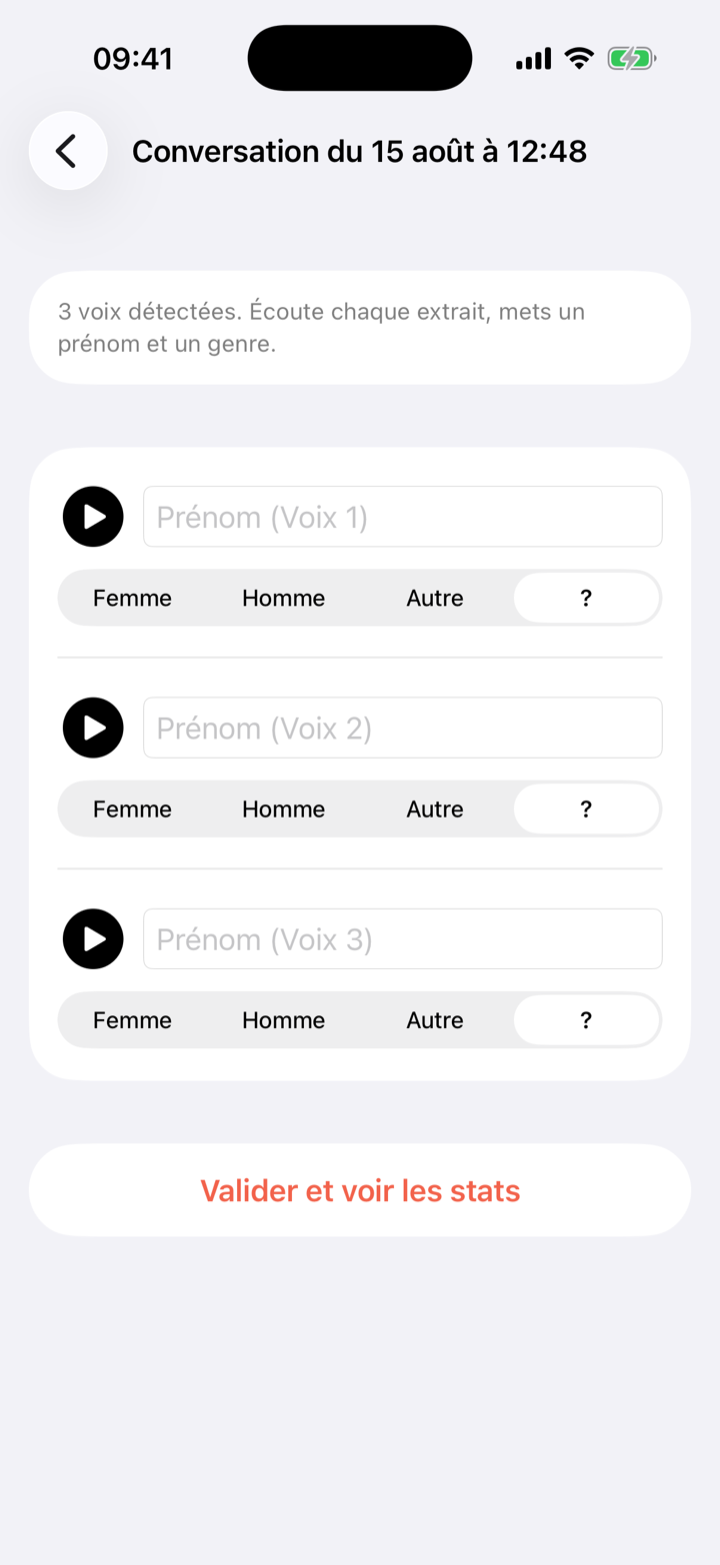
    Prints that resemble each other are filed together: those are the "voices" of the conversation. You name them by listening to a short clip of each one, and the app works out all the rest.

An interruption is a matter of geometry

When two voices overlap, the app looks at who stops, who carries on, and for how long. Four cases, rules with actual numbers, zero interpretation of the content.

Interruption

B starts speaking while A is speaking. A stops within 2 seconds, and B holds the floor for at least 1 more second. B really did take the turn.

A gives way in under 2 s · B carries on for at least 1 s

Attempt

B tries to jump in, but A keeps speaking. B ends up falling silent. The app counts an attempt: it says a lot too, but it is not a taken turn.

A holds on beyond 2 s, or B lets go of the floor too quickly

Backchannel

An "mm-hmm", a "yeah", a short laugh while A is speaking. Under 1.5 seconds, and A does not stop. Never counted against B: encouraging is not cutting in.

B lasts under 1.5 s · A carries on

Ignored, on purpose

An overlap shorter than half a second? Just speech brushing against speech, it does not count. Three voices or more at once for over 2 seconds? That is crosstalk: the whole stretch is excluded from the interruption count, and nobody is recorded there as cutting in or being cut off.

Overlap counted from 0.5 s · crosstalk from 3 simultaneous voices

Watch it work

A demo conversation (five synthetic voices, overlaps known to the millisecond) and, right beside it, what the mechanism makes of it, second by second.

Voices generated with ElevenLabs, edited with deliberate overlaps: nobody was recorded. This is the same mechanism the app applies to a real table.

The chip that makes this possible

Separating voices in hours of audio used to be data center work. What changed fits in your phone.

Yesterday: the cloud, no way around it

This kind of analysis needed servers and their graphics cards. So the audio went out over the internet, and privacy rested on a contract: "we promise we delete it afterwards". Impossible to verify from home.

Today: your pocket

Since 2017, every iPhone carries a Neural Engine: a circuit that knows how to do one thing only, artificial intelligence calculations, but dozens of times faster than the main processor and easier on the battery. It is the same chip that unlocks Face ID or finds your cat photos.

Parlotte uses it to analyse a whole evening in a few minutes, without touching the network. "Nothing leaves the phone" is not a privacy policy: it is a hardware consequence. The computation that once demanded a data center now fits inside the chip.

The four building blocks, all open or documented

  • pyannote, an open source model out of academic research (CNRS, Université du Mans), spots the moments where someone is speaking.
  • WeSpeaker, another open model, computes the acoustic print of each voice.
  • FluidAudio, an open source library, converts those models to Apple's format and orchestrates the analysis.
  • Core ML, Apple's technology, spreads each computation across the Neural Engine, the graphics chip and the processor. Apple's research on the subject is published on machinelearning.apple.com.

To be straight about it: not everything runs exclusively on the Neural Engine, Core ML distributes the work across the chips. What matters: all of them are inside the device.

The app, for real

From consent to the stats card you share with the group. Screenshots taken with sample data; the app interface is currently in French.

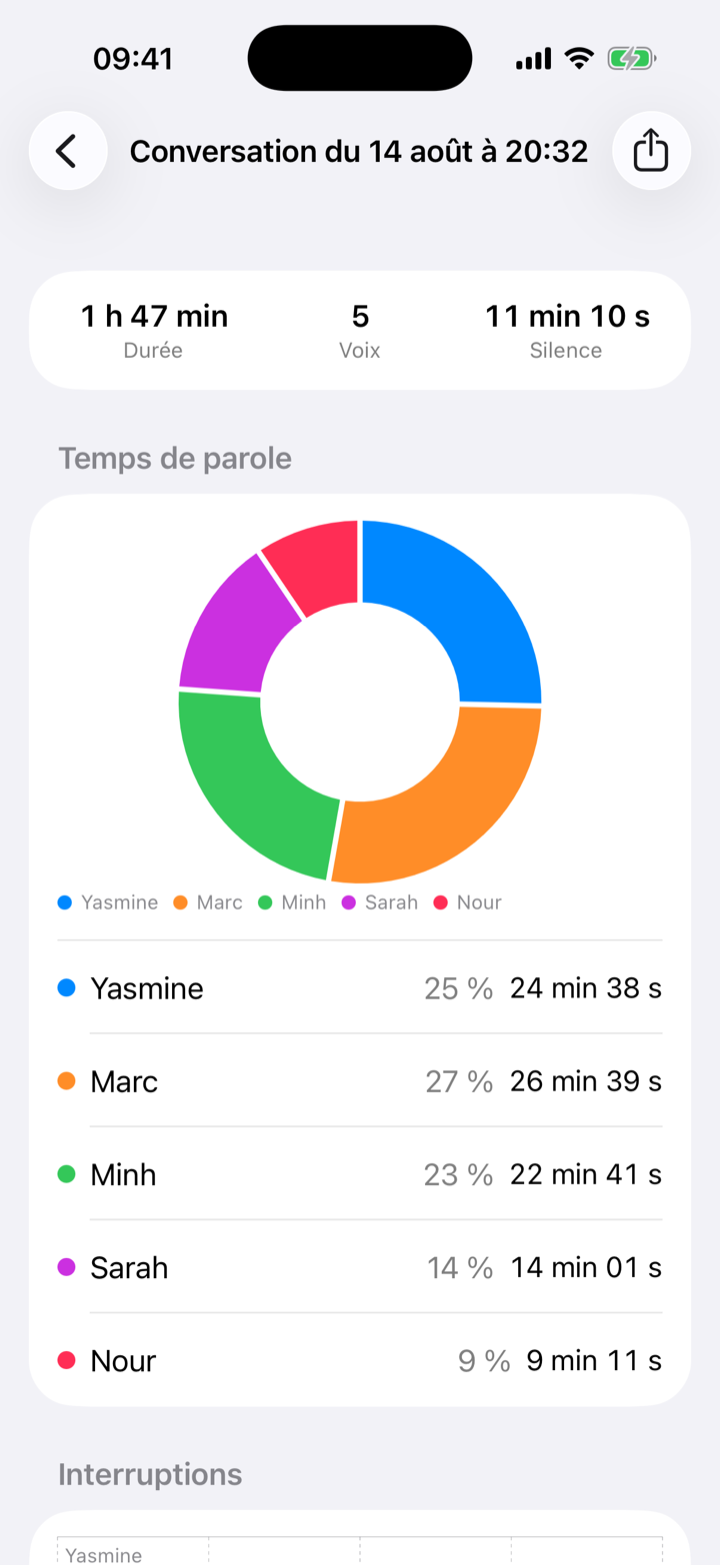
Statistics screen: pie chart of the speaking time of five people, total duration 1 h 47
The stats of the conversation: speaking time, interruptions, timeline, trophies.
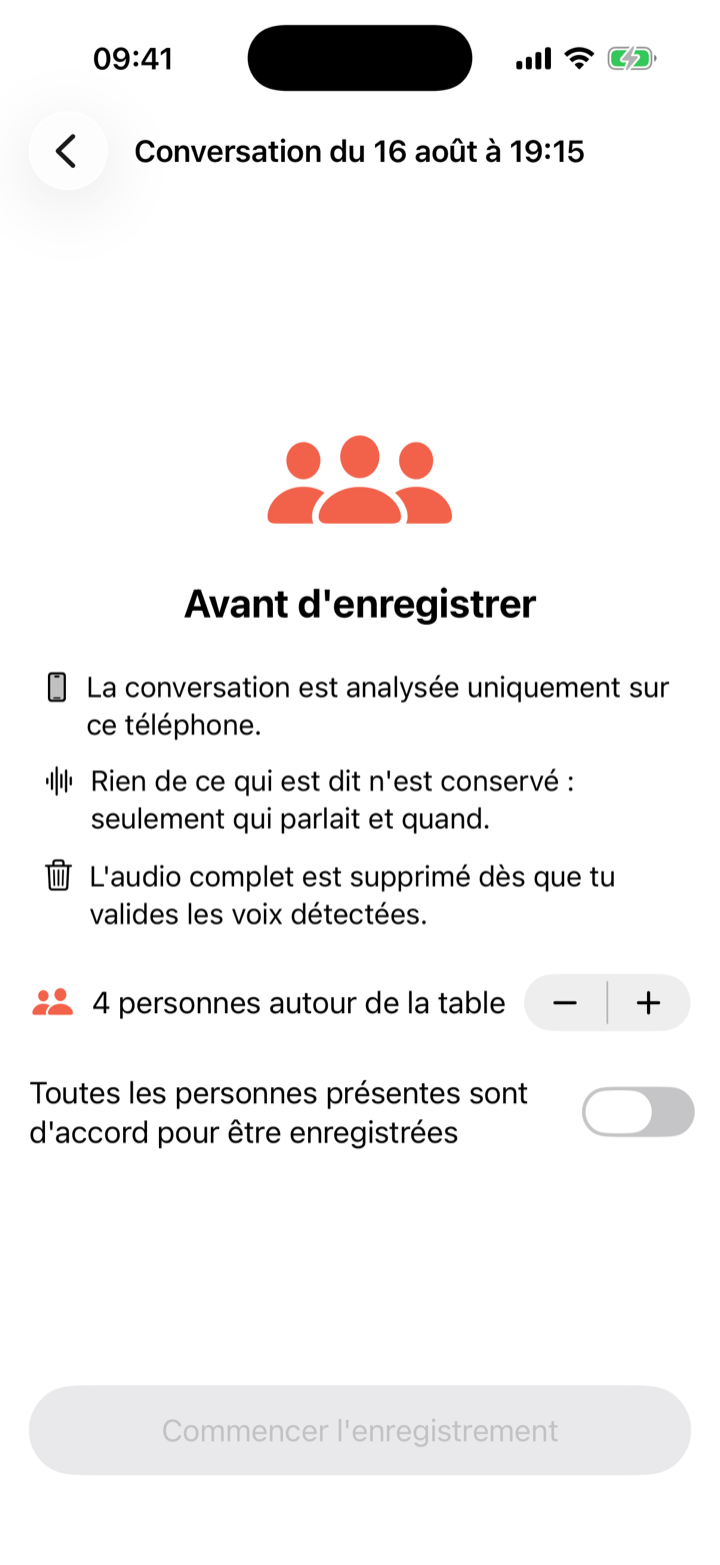
Consent screen: everyone present has to agree before recording starts
Consent first, always.
Labelling screen: three detected voices to name by listening to a short clip
A few seconds of audio per voice, a first name, a gender.
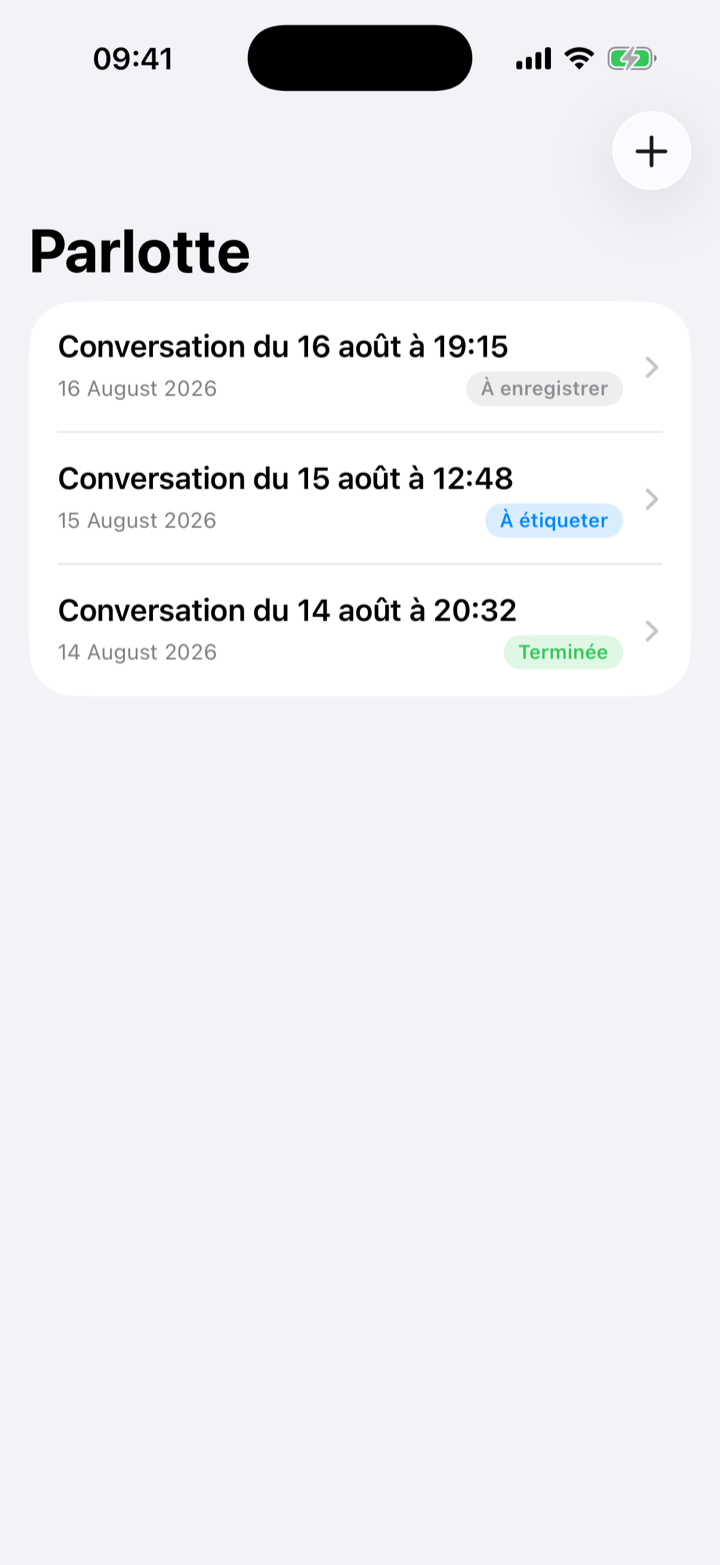
List of recorded conversations with their status
Your conversations, and nothing else: no account, no profile.

What Parlotte cannot do